

TL;DR
- AI search visibility metrics are the quantitative measures used to evaluate how often, how prominently, and how effectively a brand appears in AI-generated search and answer environments.
- Brand Presence shows whether your brand is appearing in AI answers.
- Share of Voice shows how much competitive visibility you own across the same prompt set.
- Citations show which sources are supporting the citation of your brand, and Citation Quality shows how credible and authoritative the sources citing your brand are.
- AIO Tracking shows whether your brand is surfacing in Google’s AI Overviews.
- Retrievability Tracking measures how easily and consistently your content can be found and surfaced by AI models.
- AI Referral Traffic shows when AI visibility is turning into measurable visits, while Sentiment Analysis shows whether those mentions are framed in a way that builds trust or weakens it.
I track AI search visibility metrics because they show what traditional SEO reporting often misses: whether a brand is appearing inside AI-generated answers before a click happens.
That matters now because B2B buyers are adopting AI-powered search at 3x the rate of consumers, while 80% of consumers already rely on zero-click results in at least 40% of their searches.
So in this blog, I’m focusing on the metrics that actually tell me whether AI visibility is turning into trust, traffic, and conversions.
8 AI Search Visibility Metrics That Matter for Tracking Conversions

To prove AI search drives real conversions, I track metrics that show whether a brand appears, gets cited, builds trust, and drives visits. Click-through rate alone misses most of it because AI visibility plays out inside generative answers, not blue-link rankings.
Brand Presence: Whether Your Brand Shows Up in AI Answers
Brand Presence measures whether my brand appears at all in an AI-generated answer for a relevant prompt. I start here because zero presence in AI answers explains a lot of downstream weakness: weak traffic, soft pipeline, and missed assisted conversions. Many teams jump straight to visits and leads, but those numbers cannot tell you whether the brand was visible at all.
1. Measure Brand Presence with a fixed prompt set, scored yes/no once per reporting cycle
The cleanest setup starts with a fixed prompt set and stable wording across each reporting cycle. That keeps the signal comparable and cuts down noise from prompt variation.
I usually group prompts into three buckets:
- Category prompts, such as “best CPQ software.”
- Comparison prompts, such as “Salesloft vs Outreach for mid-market teams.”
- Commercial-intent prompts, such as “best CRM for a 50-person SaaS team migrating from HubSpot.”
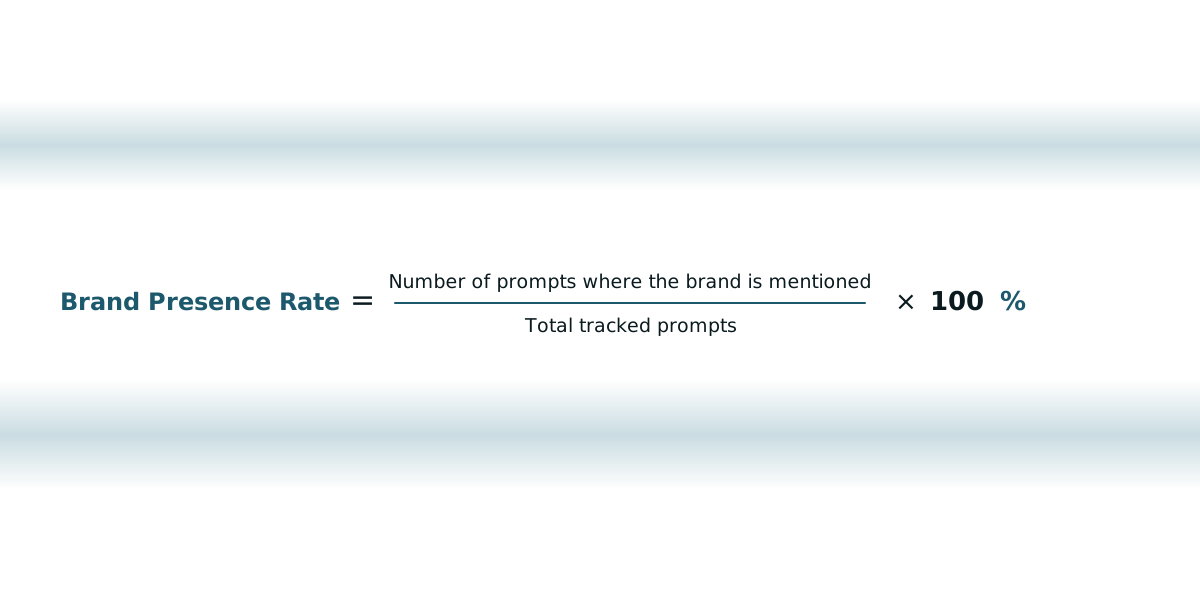
Run the same prompt set across the AI platforms that matter to your buyer journey, then mark each answer yes or no for brand inclusion. At this stage, you are checking only one thing: did the brand appear or not.
Once each prompt is marked, convert that into a rate:
2. What Brand Presence reveals about your buyer's AI-driven discovery path
Brand Presence tells you whether the brand is entering the buyer’s consideration set when AI Search platforms generate category, comparison, and shortlist-building answers. That makes it easier to tell whether the real problem starts with weak inclusion or appears later in trust, traffic, or conversion.
3. Six breakdowns to review inside your Brand Presence prompt set
The overall rate helps, but the breakdown tells you where the weakness actually sits. I would review:
- Total prompts where the brand appears
- Brand Presence Rate across the full set
- Inclusion by platform
- Inclusion by prompt type
- Inclusion by buyer stage
- Gaps where the brand should appear but does not
4. What a rising or falling Brand Presence Rate usually signals
A rising Brand Presence Rate usually means your brand is entering more relevant AI answers. A weak rate usually means the brand is still missing from important buying conversations, even when rankings or branded traffic look healthy elsewhere.
One common reporting mistake is mixing branded prompts into the main set. That makes the number look stronger than it is, because branded prompts test recall more than discovery. For B2B SaaS teams, Brand Presence becomes much more useful when most tracked prompts are non-branded and tied to real commercial intent.
Once you know you’re in the answer set, the next question is what’s supporting that inclusion: your Citations.
Citations: The Sources AI Platforms Use to Back Your Brand
Citation measures the sources AI systems use when your brand is mentioned. A mention shows that the brand appeared. A citation shows what supported that inclusion.
This metric matters because AI answer engines do not pull brand names out of thin air. In many cases, the source layer explains why one company made it into the answer while another one did not. If Brand Presence tells you that you are in the room, Citations tell you what got you there.
1. Map citation sources by recording every source attached to a brand mention
Start with the same prompt set you use for category discovery, comparison, and buying-stage evaluation. For every answer where your brand appears, record the sources attached to that mention.
The point is not to count citations in isolation. You need to see which sources appear often enough to shape answer behavior.
2. Eight signals to review inside your citation support data
The first pass should focus on a few clear signals:
- Citation frequency when the brand appears
- Owned-site citations versus third-party citations
- Citation distribution by platform
- Citation distribution by query type
- Repeated source domains across core prompts
- Unique citing domains across the prompt set
- Citation patterns by geography
- Citation drift across reporting periods
Once that is in place, look for source patterns. If the same review sites, editorial publications, partner pages, or industry resources keep showing up across your tracked prompts, that tells you where AI systems are already finding support for category-level answers.
3. What consistent versus inconsistent citation patterns usually signal
Consistent citations usually mean the system has repeatable source support behind brand inclusion. Weak or inconsistent citations often point to poor source capture, weak external validation, or a category where competitors have stronger reference points.
This is also where a lot of teams waste effort. Broad PR coverage may create mentions, but it does not always create citation support in the places that matter. You will get a better read by tracking which source ecosystems AI tools already rely on in your market, then building a stronger presence there.
4. What citations reveal about what's actually backing your AI visibility
Citations tell you what is backing your visibility once the brand appears in an answer. That matters because a mention supported by strong documentation, trusted third-party reviews, or credible editorial coverage carries much more weight than a mention with weak source support.
In practical terms, this metric helps you answer:
- What sources are actually supporting our inclusion in AI answers?
- Are AI systems relying on our site, external reviews, or editorial references?
- Where should we build authority if we want stronger and more stable citation support?
A count of sources is useful, but we must also assess the strength of that support, which brings us to Citation Quality.
Citation Quality: How Much Authority the Sources Behind Your Brand Carry
Citation Quality measures the authority, relevance, specificity, and trustworthiness of the sources behind brand mentions. I watch this closely because it tells me whether visibility has solid support behind it or whether the brand is showing up on weak footing.
Many teams stop at “we got cited” and move on. That misses the harder part of the analysis. A citation from a current category guide, respected editorial page, or well-maintained documentation hub carries much more weight than one from a thin roundup or stale directory page.
1. Assess Citation Quality by scoring each source against a consistent five-check evaluation
I review the sources attached to brand mentions and score them against a small set of checks that stay consistent across prompts and platforms. I do not need a perfect model here. I need one that lets me compare source strength without changing the rules every cycle.
2. Five quality dimensions to score every cited source against
The main checks usually include:
- Authority level of the referring source
- Topical fit between the cited page and the prompt
- Freshness of the cited material
- Specificity of the supporting content
- Whether the cited source strengthens trust or signals weak support
I also compare that source mix against the strongest competitors in the same prompt set. That comparison matters because a similar mention volume can hide a major gap in source strength.
3. What high versus low Citation Quality usually signals about trust
High citation quality usually means the brand is being supported by sources that fit the category, answer the prompt clearly, and carry enough trust to justify inclusion. Low citation quality usually means the brand may still appear, but the backing behind that visibility is too generic, too old, or too thin to hold up well across similar prompts.
This is where weak trust signals start to show up in a very practical way. If mentions rise but citation quality stays poor, AI search visibility metrics can still struggle to move commercial outcomes. In that situation, the brand may be visible without becoming convincingly recommendable.
4. What Citation Quality reveals about whether mentions are recommendable
Citation Quality helps me separate “we are getting mentioned” from “we are getting supported by the right kind of source.” That difference shapes how I read later signals like sentiment, AI referral traffic, and repeat inclusion across commercial prompts.
When this metric is weak, I usually know the problem is not just visibility. The problem is that the source layer behind that visibility is not strong enough to build stable confidence.
Strong citation quality helps, but it still does not show whether your brand is winning enough visible space in the category. That is where Share of Voice comes in.
Share of Voice: How Much of the Category's AI Answer Space You Own Against Competitors
Share of Voice measures your brand’s percentage of total category visibility against competitors across the same tracked prompt set. Brand Presence tells me whether the brand appeared at all. Share of Voice shows whether that visibility is strong enough to matter in a competitive market.
Teams often stay in single-brand reporting because it feels cleaner and easier to explain. That view misses what is actually happening. A brand can improve its own visibility and still lose position if competitors gain more answer space across the same category prompts.
1. Calculate Share of Voice with a fixed competitive prompt set tracked over time
I use the same prompt set across every platform I monitor and record each brand that appears in the answer. That gives me a stable denominator, which matters because Share of Voice only becomes reliable when it is tracked across the same prompt set over time.
I also watch for drift, since a one-time number can look fine while the trend shows the brand slowly losing answer space. Once the mentions are recorded, I calculate the share my brand owns across the full competitive set. Once the mentions are recorded, I calculate the share my brand owns across the full competitive set:

2. Five competitive views to break Share of Voice down by
I usually break Share of Voice into a few views so the number is easier to diagnose:
- Total category mentions
- Platform-level share
- Prompt-cluster share
- Competitor-by-competitor share
- Share of Voice drift across reporting periods
That breakdown matters because an overall score can hide where the gain or loss is happening. A brand may hold steady in broad category prompts and still lose ground in commercial comparison prompts where buying decisions take shape.
3. What a rising or falling Share of Voice usually signals about market position
A rising Share of Voice usually means the brand is taking up more of the visible answer space in the category. A falling Share of Voice usually means competitors are gaining more inclusion, even when your own mention count stays flat or inches up.
This is one of the most useful metrics for leadership reporting because it shows market position, not just internal progress. I rely on it when Brand Presence improves but the business still feels stalled, because that often points to a competitive visibility problem rather than a pure inclusion problem.
4. What Share of Voice reveals about ground you're gaining or losing against competitors
Share of Voice helps me judge whether the brand is actually gaining ground in the category or just showing up often enough to look stable in isolation.
It gives a clearer read on whether competitors are taking more answer space, whether recent gains are meaningful, and whether the brand is becoming more visible where shortlist decisions are being shaped.
Share of Voice shows category-level competitive visibility, but it does not show how that visibility plays out inside Google’s AI layer, which is why I track AIOs separately.
AIO Tracking: How Often Google's AI Overview Mentions Your Brand
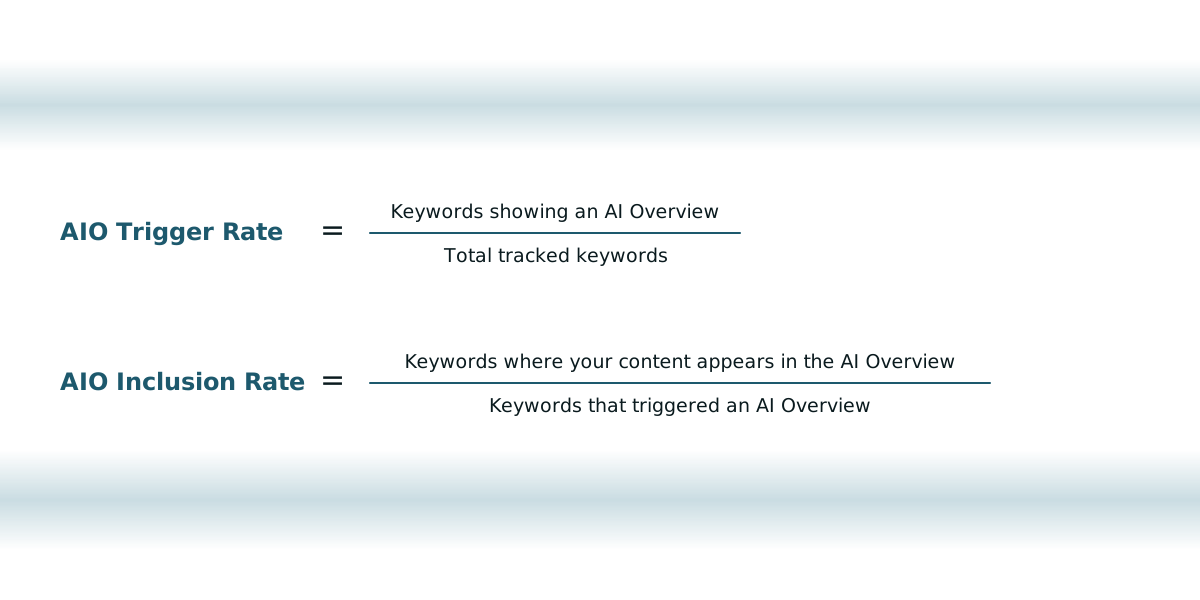
AIO Tracking measures how often your brand appears in Google AI Overviews and how often your tracked queries trigger them. I keep this metric separate because Google still drives a huge share of discovery, and its AI layer can change what your buyer sees before your site gets a click.
This matters because a drop in clicks does not always mean your visibility got worse. Sometimes Google is answering more of the query inside the results page. Other times, your target queries are triggering AI Overviews and your brand is simply not being included.
1. Measure AIO presence by tracking trigger rate and inclusion rate across a fixed keyword set
I start with a fixed keyword set built around your category, your comparison terms, and your commercial-intent queries. For each keyword, you need to record two things:
- Whether an AI Overview appeared
- Whether your brand or page appeared inside it
Then calculate:
I also check Search Console for those same queries and pages, but only as supporting evidence. It helps you spot direction, not isolate AI Overview performance cleanly on its own.
2. Five views to break AIO presence down across your tracked queries:
- Percentage of tracked keywords triggering AI Overviews
- Inclusion rate within those overviews
- Branded AIO presence
- Non-branded AIO presence
- Movement by page type and query class
This breakdown helps you see where the real issue sits. Your branded queries may look fine while your non-branded commercial terms are losing visibility.
3. What rising or falling AIO inclusion usually signals about authority and content format
High AIO presence usually means Google sees your content as useful enough to include in its AI answer layer. Weak AIO presence often points to authority gaps, content-format issues, or page-level retrieval problems. I also read this in context, because AIO presence varies a lot by industry. Informational categories such as healthcare and B2B technology tend to surface more often than transactional ones such as restaurants or travel, while finance and e-commerce still see more limited AIO rollout.
The biggest reporting mistake here is relying on impressions alone. That does not tell you whether the query triggered an AI Overview or whether your brand was part of it.
Search Engine Land reported that AI Overviews appeared in 13.14% of U.S. desktop searches in March 2025, up from 6.49% in January, based on Semrush and Datos data. That matters because more searches can end without a click even while your visibility is shifting upward.
4. What AIO Tracking reveals about Google's role in pre-click visibility
AIO Tracking helps you tell whether weak performance is coming from low inclusion, rising zero-click behavior, or a change in how Google is answering the query itself.
Once you know how often your brand appears in Google’s AI layer, the next question is whether that visibility is turning into actual visits: AI Referral Traffic.
AI Referral Traffic
AI Referral Traffic measures visits that reach your site from AI platforms and AI-linked answer environments. I pay close attention to it because it is the clearest place where AI search visibility metrics start showing up as site behavior, even though it still captures only the click-visible part of the journey.
A lot of teams trust this metric too quickly because it looks familiar inside analytics. I understand why. It feels concrete. Still, AI Referral Traffic will miss the buyer who sees your brand in an answer, leaves, comes back through branded search, and converts later in a different session.
1. Measure AI Referral Traffic by isolating ChatGPT, Perplexity, Claude, and Gemini sources in analytics
I start by isolating AI-origin traffic inside analytics using referral source and source/medium patterns. Then I group visits from ChatGPT, Perplexity, Claude, Gemini, and similar sources into one reporting view so I can read the trend cleanly.
The formulas I use most are:

2. Six things to review inside your AI-referred sessions
Once the segment is clean, I look at the parts of the visit that tell me whether the traffic has real buying intent:
- Session volume from AI sources
- Landing pages receiving that traffic
- Engagement quality of AI-referred visitors
- Conversion performance of AI-referred sessions
- Differences across AI platforms
- Trend shifts across reporting periods
The landing-page view matters more than many teams expect. If your AI traffic keeps landing on educational pages and never reaches commercial pages, your visibility may be broad without being commercially useful.
3. What strong versus weak AI Referral Traffic usually signals about buying intent
I do not treat low volume as a weak value by default. In B2B SaaS, I have seen smaller AI referral segments produce stronger conversion quality than larger organic segments because the answer already did part of the qualification work before the visit happened.
This is also where you can separate zero-click exposure from measurable visits. If referral traffic stays modest but the sessions that do arrive show strong engagement or conversion behavior, AI visibility may already be influencing your funnel before the click.
4. What AI Referral Traffic reveals about post-click commercial value
I use this metric to judge whether AI visibility is creating site behavior that connects to commercial intent.
It helps me understand whether your AI presence is bringing useful visits, which platforms are sending stronger traffic, and whether weak volume points to a visibility problem or strong pre-click influence with fewer clicks.
AI Referral Traffic shows whether visibility is turning into visits. Sentiment Analysis shows how your brand is being described before those visits happen.
Sentiment Analysis: How AI Platforms Frame Your Brand in Their Answers
Sentiment Analysis measures how positively, neutrally, or negatively your brand is framed in AI-generated answers. I keep it in the reporting set because AI search visibility metrics are not only about whether your brand appears. They also need to tell you how your brand sounds once it enters the answer.
A lot of teams push this metric aside because it feels less concrete than visits or conversions. I think that leads to shallow diagnosis. A brand can show up often and still lose momentum if the language around it feels hesitant, generic, or qualified in the wrong way.
1. Score answer framing by stance, not just emotional tone
I track stance, not just emotion. That means I look at how the answer positions your brand inside the recommendation, not just whether the wording feels positive or negative on the surface.
When you review this metric, it helps to score answers against the same rules each cycle so the pattern stays comparable.
2. Five framing dimensions to review across the answer set
- Positive, neutral, and negative framing
- Whether your brand is presented as preferred, secondary, or risky
- Differences in sentiment by platform
- Differences in sentiment by prompt type
- Whether commercial-intent prompts produce weaker framing than category prompts
That last check matters more than many teams expect. A brand can sound strong on broad educational prompts and still sound uncertain on shortlist-building prompts, which is where the real buying signal sits.
3. What trust-building versus hedged framing usually signals about pipeline impact
Strong sentiment means your brand is present and described in a way that supports trust. Weak or uncertain sentiment often explains why Brand Presence fails to turn into clicks, qualified visits, or commercial action.
I have seen brands with solid inclusion rates still struggle because the answer language stayed lukewarm. When AI systems frame a product as “good for some cases” or “worth considering,” buyers usually read that very differently from “best fit” or “strong choice.”
4. What Sentiment Analysis reveals about whether your brand sounds recommendable
This metric helps you judge whether AI systems are making your brand sound credible enough to move buyers forward. It also helps you tell whether weak downstream performance comes from poor framing rather than poor visibility.
In practical terms, you can use it to judge whether your brand is building trust, getting treated like a backup option, or carrying hidden friction inside comparison-style answers.
A strong mention can still rest on weak delivery. That is why, after Sentiment Analysis, I look at whether the underlying pages are actually retrievable.
Retrievability Tracking: Whether Your Key Pages Are Eligible to Appear in AI Answers
Retrievability Tracking measures whether priority content can be crawled, indexed, understood, and retrieved by LLMs and search engines. I keep this metric close to the top because a page can be live, well-written, and even lightly ranked, yet still fail to show up in AI answers if retrieval systems cannot process it cleanly.
A lot of teams assume published content is automatically retrievable. That assumption creates bad diagnosis. If a page is hard to fetch, hard to render, poorly linked, or structurally inconsistent, your AI search visibility metrics will stay weak no matter how strong the copy looks on the page.
1. Audit retrieval readiness by checking priority URLs against a six-point grading mechanism
I start with a priority URL set, usually the pages tied most closely to revenue, commercial-intent discovery, and product comparison. Then I audit the retrieval path around those pages instead of judging the content in isolation.
If you only review the page copy, you will miss the technical reasons retrieval keeps failing.
2. Six retrieval checks every priority URL should pass
My main checks are:
- Crawlability
- Indexability
- Renderability
- Canonical consistency
- Structured-data clarity
- Internal link support to priority pages
- Retrieval gaps on pages I expected to appear in answers or citations
I also compare those URLs against the pages that actually surface in AI answers. That contrast often shows whether the issue starts with content quality or with access and interpretation.
3. What weak retrieval usually signals about why the content isn't appearing
Strong content on a weak retrieval path still underperforms. If priority pages are not being crawled cleanly, rendered correctly, or interpreted consistently, AI systems have less to work with, and visibility drops before the buyer ever sees the brand.
This is one of the quieter failure points in AI search visibility metrics. A page can have the right topic, strong intent match, and decent on-page execution, yet still miss inclusion because the retrieval layer is weak.
4. What Retrievability Tracking reveals about whether content or technical gaps are blocking visibility
I use this metric to work out whether a visibility gap starts with the content itself or with the page’s technical eligibility for retrieval. That makes it useful when you need to decide whether to rewrite the page, fix the render path, clean up canonicals, improve schema, or strengthen internal linking.
If your highest-value pages are not consistently accessible to LLMs and search engines, you will struggle to earn stable visibility no matter how good the messaging is.
How These Metrics Work Together As One AI Visibility System
AI search visibility metrics matter when they show whether your brand is being surfaced, trusted, and moved closer to conversion. I read Brand Presence, Citations, Citation Quality, Share of Voice, AIO Tracking, AI Referral Traffic, Sentiment Analysis, and Retrievability Tracking as one system, because each explains a different part of AI-led discovery.
Three limits still matter: zero-click search, delayed return visits, and mixed-device journeys can hide part of the buyer path. So I treat these metrics as decision signals with real commercial value, not as perfect proof of every touchpoint.
Track All 8 Metrics From One Dashboard
See your brand presence, citations, share of voice, and sentiment across every major AI platform without manual prompt runs.
Book a DemoFrequently Asked Questions
AI referral traffic is the clearest link. Citations show what supports visibility, share of voice shows competitive visibility, and AI referral traffic shows whether that visibility is turning into site visits.

Pushkar Sinha
Head of SEO Research
Pushkar leads SEO Research at VisibilityStack, driving the development of proprietary methodologies and frameworks that power our platform. His deep expertise in search algorithms and AI systems informs our technical approach. Pushkar has led SEO research initiatives at multiple technology companies, developing frameworks that have driven hundreds of millions in organic pipeline for B2B SaaS clients.


